 University IT
Transcripts for Audio
Podcasts and other audio programs have opened up learning, entertainment, and community for millions of people. But when information lives only in sound, large groups of listeners are excluded or forced to work much harder to access it. Transcripts—accurate, readable text versions of audio—are a simple, powerful way to make podcasts truly inclusive. For people with disabilities, transcripts are not a "nice to have"; they are essential infrastructure for equal access.
Transcripts give Deaf and hard of hearing listeners a direct path to the content, rather than relying on imperfect lip-reading, captions embedded in video, or secondhand summaries. They also support DeafBlind people who use refreshable braille displays, and anyone who depends on assistive technologies that interact with text. Without a transcript, a podcast episode can be effectively silent for these audiences. With a transcript, the same episode becomes readable, searchable, and usable—opening the door to information, community, and participation.
Presentation Techniques
Unfortunately, as of 2025, most of the major podcast platforms do not have a transcript option available. Therefore, you need to put the transcript in another location, such as on your website where you embed the podcast.
There are numerous ways the transcripts may be presented to users. Some techniques include having the content right below the audio player, having the transcript as an appendix that is linked to, having another page, or whatever technique is preferred. When using a podcast service that lacks the option for transcripts, often a link can be added in the description to whatever page on your site has the transcript available.
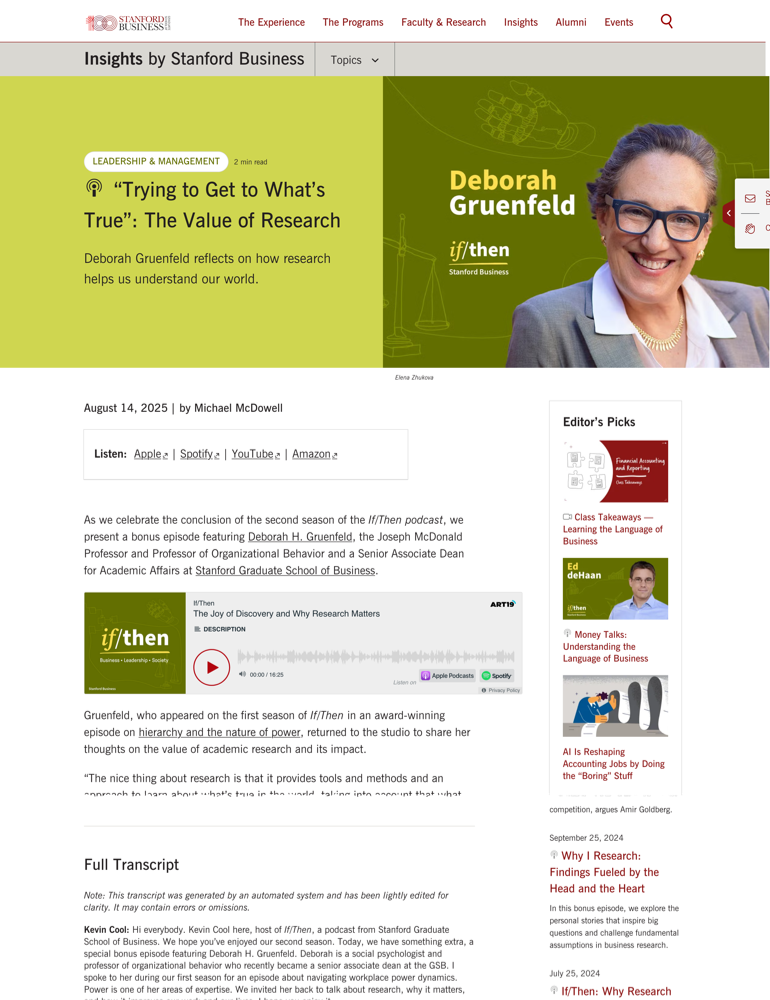
One example of a well done transcript would be on the Stanford Graduate School of Business: If/Then podcast. A full transcript is listed lower on the page that a user can easily find.